
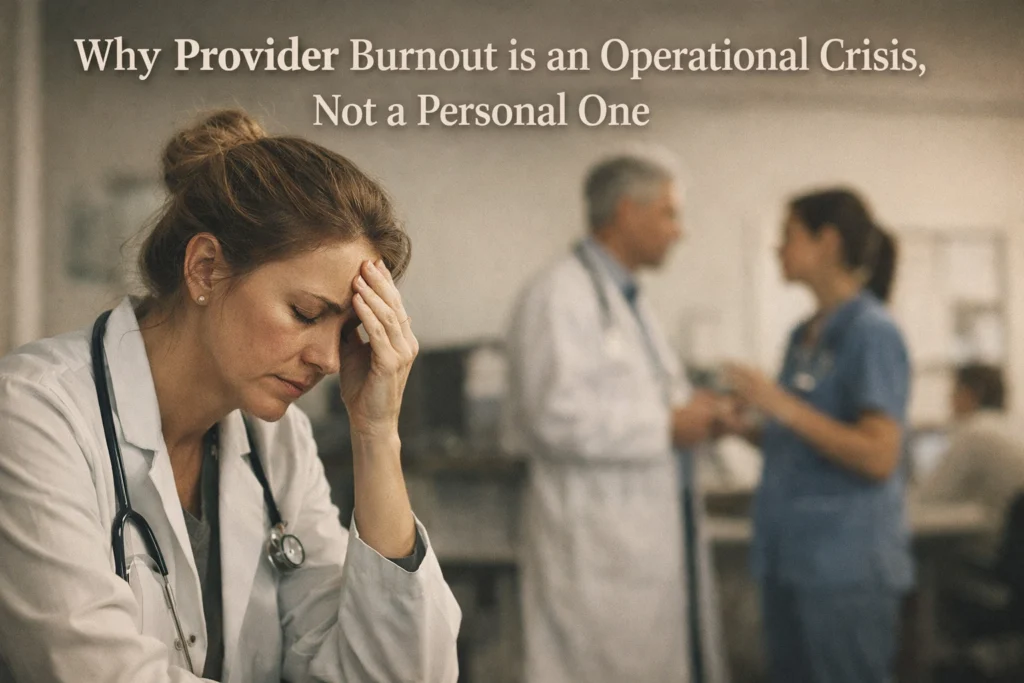
Your best provider just handed in their notice. Again.
They're exhausted, overwhelmed, and apologetic. They mention "needing better work-life balance" or "taking time to focus on personal wellness." And because they're good people who care deeply about their work, they blame themselves.
But here's what most practice owners miss: Provider burnout isn't a personal failure. It's an operational one.
When 70% of your clinical staff reports feeling burnt out, that's not a coincidence. That's not a string of bad hires or people who "just can't handle it anymore." That's a flashing red light on your dashboard telling you something in your system is fundamentally broken.
The Real Numbers Behind the Crisis
Before COVID-19, burnout rates hovered around 40-50% among physicians and nurses. During the pandemic, those numbers skyrocketed to 70-90%. Today, even as we've moved past the acute crisis phase, burnout remains stubbornly high across healthcare practices of all sizes.
Here's what that looks like in dollars and cents: replacing a single burnt-out physician costs your practice up to $500,000 in recruitment, onboarding, lost productivity, and team disruption. Multiply that across multiple providers over a few years, and you're looking at a seven-figure operational problem.
But the financial hit is just the beginning. Burnt-out providers make more medical errors. Studies show that burnout levels in ICU staff directly predict patient mortality and infection rates. When your team is running on empty, patient safety suffers. Your reputation suffers. And your business growth solutions become impossible to implement because you're constantly in crisis mode.

Why "More Self-Care" Isn't the Answer
Most practice owners respond to burnout the same way: wellness programs, mindfulness apps, yoga classes, and encouragement to "take better care of themselves."
These aren't bad things. But they're band-aids on a structural problem.
The real drivers of provider burnout are organizational:
Administrative overload , Your providers spend 30-50% of their time on non-clinical tasks. Documentation, insurance authorizations, billing inquiries, compliance paperwork. That's not burnout from providing care. That's burnout from managing broken processes.
Chronic understaffing , When one provider calls out sick, everyone else absorbs the overflow. Lunch breaks disappear. Patient visits get rushed. Quality suffers. And the cycle accelerates because stressed providers get sick more often.
Decision fatigue from poor systems , Every day, your team makes hundreds of micro-decisions that shouldn't require their attention. Which forms to use. How to route a specific type of patient. Where to find the information they need. Each decision drains cognitive energy that should go toward patient care.
These are operational problems. And operational problems require operational solutions.
The Hidden Cost of Treating Symptoms Instead of Systems
When you frame burnout as a personal issue, you end up with personal solutions. More PTO. Employee appreciation events. Wellness stipends.
Again , these aren't bad. But they don't address the underlying operational failures that create burnout in the first place.
Meanwhile, the real costs compound:
Your best providers leave for practices with better systems. The remaining team absorbs more work. Burnout accelerates. Patient experience declines. Online reviews suffer. Revenue growth stalls. Your ability to attract top talent weakens because word gets out that your practice is "a tough place to work."
This is the operational death spiral that happens when you treat a systems problem like a people problem.

What Operational Burnout Actually Looks Like
Let's get specific. In most practices generating $500K-$4M in revenue, burnout shows up in predictable operational patterns:
Providers arrive early and stay late : Not because they're passionate workaholics, but because the only way to complete their documentation is outside patient hours. Your EHR system requires too many clicks. Templates aren't optimized. The workflow doesn't match how care actually gets delivered.
The same questions get asked repeatedly : Your team doesn't have clear protocols for common scenarios. Everyone reinvents the wheel. Knowledge lives in people's heads instead of accessible systems. New staff take forever to onboard because there's no documented process.
Administrative tasks consume provider time : Instead of delegating appropriately, your highest-paid clinical staff spend their time on tasks that should be systematized or handled by support roles. But you can't delegate effectively because the systems aren't in place to support delegation.
Decision-making bottlenecks around leadership : You're the only one who knows how certain things work. Providers interrupt you constantly for answers. You can't take a day off without everything grinding to a halt. This isn't because you have irreplaceable expertise: it's because your operational knowledge isn't documented or systematized.
This is where business coaching focused on operational infrastructure makes the difference. Because burnout isn't about your people lacking resilience. It's about your systems lacking efficiency.
The Marblism Factor: Technology as Operational Leverage
One of the fastest ways to reduce operational burnout is eliminating the administrative friction that consumes provider time and energy.
Modern practices are increasingly using custom automation tools to handle the repetitive, time-consuming tasks that drain clinical staff. Patient intake workflows, appointment reminders, documentation templates, and internal communication systems can all be optimized to reduce cognitive load.
Platforms like Marblism enable practices to build custom operational tools without requiring a full development team or massive IT budget. Instead of forcing your providers to adapt to generic software that doesn't match your workflow, you can create systems that actually support how your team delivers care.
The result? Providers spend less time clicking through clunky interfaces and more time doing what they were trained to do. Administrative burden drops. Documentation happens faster. And the operational friction that creates burnout starts to disappear.
This isn't about adding more technology for technology's sake. It's about using the right tools to fix broken operational processes that your team has been compensating for through sheer willpower.

Leadership Commitment: The Missing Ingredient
Dr. Lotte Dyrbye, a leading researcher on healthcare workforce burnout, puts it clearly: "Core to really addressing the issue of healthcare worker burnout is leadership commitment."
Not commitment to wellness programs. Commitment to operational transformation.
That means:
Acknowledging that burnout is a systems problem : Stop asking why your providers can't handle the workload. Start asking why the workload is designed this way in the first place.
Investing in operational infrastructure : Technology, process documentation, delegation frameworks, and support staffing aren't "nice to haves." They're essential operational components that protect your most valuable asset: your clinical team's capacity to deliver quality care.
Measuring operational efficiency, not just clinical productivity : Track how much time providers spend on non-clinical tasks. Monitor documentation burden. Measure decision-making bottlenecks. What gets measured gets managed.
Creating feedback loops that drive operational improvement : Your frontline team knows exactly where the operational breakdowns happen. But if there's no structured way to capture and act on that feedback, nothing changes.
This is what effective business growth solutions look like in healthcare practices. Not marketing tactics or revenue optimization strategies, but operational foundations that make sustainable growth possible.
What Comes Next
If you're reading this and recognizing your practice in these patterns, you're not alone. Most healthcare practice owners inherited operational systems that were never designed to scale. You've been compensating through hustle, heroic effort, and constantly putting out fires.
But there's a better way.
Reducing provider burnout starts with honest operational assessment. Where are the bottlenecks? What administrative tasks consume provider time? Which decisions require unnecessary leadership involvement? What processes exist only in people's heads?
Then it's about systematically building the operational infrastructure that allows your practice to run smoothly without burning out your team.
This is the work we do with healthcare practice owners every day. Not surface-level wellness initiatives, but deep operational transformation that creates sustainable, scalable practices where good people can do their best work.
Ready to diagnose the operational gaps creating burnout in your practice? Book a 15-minute session and let's identify where to start.
Because your providers' exhaustion isn't a personal problem. It's an operational one. And operational problems have operational solutions.