
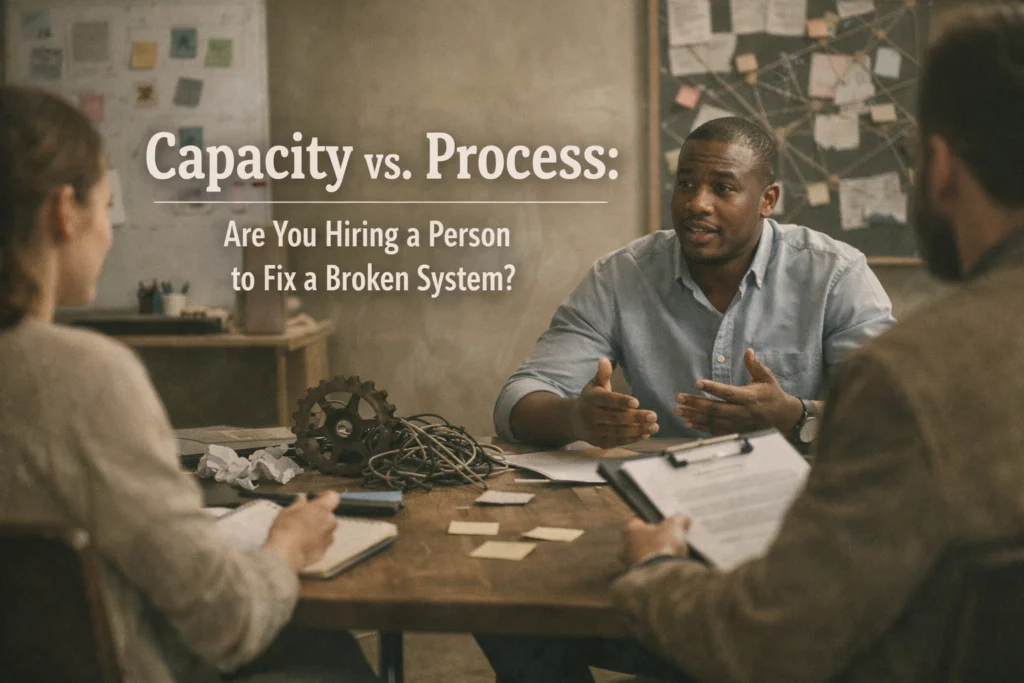
You're three weeks behind on patient callbacks. Your front desk is drowning. Your clinical staff looks exhausted. The obvious answer? Hire someone.
But before you post that job listing, ask yourself one uncomfortable question: Are you hiring a person to fix a broken process?
Most healthcare practice owners don't pause long enough to answer that question honestly. They see the pile-up, feel the pressure, and default to the quickest solution: adding headcount. It's instinctive. It feels productive. And it almost always makes the problem worse.
The Real Question: Capacity or System?
Here's the distinction that changes everything:
A capacity problem means you don't have enough people to handle the volume of work your systems can already manage efficiently.
A system problem means your processes are so disorganized, redundant, or poorly defined that no amount of staffing will solve it.
Most practice owners assume they're dealing with capacity. In reality, they're dealing with systems: or the lack of them.

If your intake process requires six different people to touch the same patient file, hiring a seventh person doesn't fix anything. It just adds another hand to a fundamentally broken workflow.
If your scheduling system requires manual coordination across three platforms, bringing on another scheduler won't reduce chaos. It multiplies it.
And if your billing team is constantly chasing down missing information because your front desk didn't collect it, hiring more billers just spreads the inefficiency across more paychecks.
The Signs You're Treating the Wrong Problem
Here's how you know you're hiring to patch a process problem:
The new hire gets stuck immediately. They ask questions no one can answer clearly. There's no onboarding roadmap. Every task requires a different workaround. Within two weeks, they're as frustrated as the rest of your team.
The workload doesn't actually decrease. You added someone, but everyone still feels overwhelmed. That's because the bottleneck wasn't volume: it was confusion. More people navigating a messy system just creates more collisions.
Mistakes increase instead of decrease. When processes aren't standardized, every additional person introduces a new variation. What worked for one staff member doesn't work for another. Errors compound. Rework doubles.
You find yourself hiring again within six months. Because the original problem never got solved. You added capacity to a system that couldn't absorb it, so now you're convinced you need even more capacity. The cycle continues.
These are the hallmarks of operational inefficiency in healthcare: and they don't resolve with headcount alone.
Why Hiring Fixes Nothing If the System Is Broken
Let's be direct: Hiring into a broken system is expensive theater.
You pay for recruitment. You pay for onboarding. You pay for salary and benefits. And in return, you get someone who inherits the same chaos your existing team is already managing.
The work doesn't get easier. It just gets distributed across more confused people.
Here's what actually happens when you hire without fixing the process first:
- Duplication increases. More people means more handoffs, more redundant communication, and more opportunities for things to fall through the cracks.
- Accountability disappears. When everyone touches everything, no one owns anything. Tasks get dropped because "someone else was handling it."
- Training becomes impossible. You can't train someone on a process that doesn't exist. So every new hire learns a slightly different version of "how we do things," and consistency erodes further.

This isn't theoretical. I've watched practice owners hire three people to solve a problem that could have been fixed with one well-documented workflow and a $200 software adjustment using tools like Marblism, which helps healthcare practices automate repetitive admin tasks without the overhead of a full custom system.
The staffing bill went up. The problem didn't go away.
The Real Cost of Misdiagnosis
Here's what most practice owners don't calculate: the cost of hiring the wrong solution.
Let's say you bring on a full-time admin at $45,000 per year to manage patient intake. But your intake process is a mess: disconnected forms, unclear handoffs, missing documentation requirements.
That new hire spends half their time figuring out what's supposed to happen and the other half redoing work that wasn't done right the first time. You're not getting $45,000 worth of productivity. You're getting $20,000 of output and $25,000 of organizational drag.
Now multiply that across multiple hires. Factor in turnover when those employees burn out from navigating a chaotic system. Add the cost of mistakes, rework, and patient dissatisfaction.
You're not solving a capacity problem. You're funding one.
And here's the brutal truth: your competitors who fix their systems first will outpace you every time. They'll deliver better patient experiences with leaner teams, higher margins, and less stress. That's the real competitive advantage in healthcare staffing solutions: not who hires fastest, but who hires smartest.
How to Tell the Difference
So how do you know whether you need more people or better systems?
Start by mapping your workflows. Not the ideal version: the actual version. Follow one task from start to finish and count:
- How many people touch it?
- How many handoffs occur?
- How many tools or platforms are involved?
- How many times does someone have to ask a clarifying question?
- How many steps could be eliminated or automated?
If the answer to most of those questions is "too many," you have a system problem.

Next, ask your team this question: "If we hired someone tomorrow, what would you have them do?"
If the answers are vague: "help with overflow," "take some stuff off my plate," "just be another set of hands": that's a red flag. You don't have a clear role to fill. You have an unclear process that's overwhelming everyone.
But if your team can immediately describe a specific, repeatable set of tasks that are currently going undone or delayed because of volume, not confusion: that's a capacity problem. And hiring makes sense.
What to Do Instead
If you've identified a system problem, here's your next move:
Fix the process before you hire the person.
Start small. Pick one recurring bottleneck: scheduling, billing follow-up, patient intake, referral management: and document it. Write down every step. Identify redundancies. Eliminate unnecessary handoffs. Standardize the language and tools everyone uses.
Then automate what you can. Tools like Marblism can eliminate hours of manual admin work by building lightweight custom workflows tailored to your practice: without the need for expensive development or IT overhead. It's the kind of operational efficiency in healthcare that buys you breathing room before you ever post a job ad.
Once the process is clean, then assess whether you still need to hire. You might. But you'll be hiring into a system that actually works: and that new person will be productive from day one instead of drowning in chaos.
If you're still not sure where to start, book a 15-minute session and we'll walk through your biggest staffing pain point together. Sometimes the best hire is the one you didn't make: because you solved the real problem first.
The Bottom Line
Hiring is not a strategy. It's a response.
And if you're responding to a broken system by adding more people, you're not building capacity: you're scaling confusion.
The practices that thrive aren't the ones with the biggest teams. They're the ones with the cleanest systems. They know the difference between being understaffed and being disorganized. And they fix the right problem first.
Before you hire, ask yourself: Am I adding a person to solve a problem, or am I adding a person to avoid solving it?
The answer will save you thousands of dollars, countless hours, and a lot of unnecessary frustration.

Ready to stop hiring your way out of process problems? Book a 15-minute strategy session and let's map out what's actually broken: and how to fix it without adding headcount you don't need. Business coaching for healthcare practices isn't about telling you to work harder. It's about helping you work smarter.