

You're at the office before your staff arrives. You leave after they're gone. Your inbox has 47 unread messages, three fires need putting out before lunch, and somewhere in there, you're supposed to actually see patients.
Sound familiar?
Here's the thing most practice owners don't realize: you're not bad at time management. Your systems are bad at protecting your time.
The Hidden Cost of "Just Five Minutes"
Every interrupted task costs you more than the interruption itself. When your front desk pulls you out of a patient room to approve a schedule change, that's not five minutes: it's fifteen. Five for the interruption, ten to regain focus and context on what you were doing.
Multiply that by a dozen interruptions daily, and you've lost two to three hours. Not to task completion: to task switching.

The average healthcare practice owner spends 31% of their day on administrative tasks that could be systematized. That's roughly 12 hours per week spent answering questions that shouldn't need asking, approving decisions that shouldn't need approving, and fixing problems that shouldn't be happening.
Why "Working Harder" Isn't the Answer
Most practice owners respond to time pressure the same way: longer hours, faster decisions, less delegation.
It doesn't work.
Why? Because you're treating a systems problem like a personal capacity problem. You can't personally scale. Your systems can.
When practices implement structured workflows: even basic ones: using tools like Marblism to automate routine decisions and approvals, they immediately see 15-25% time savings. Not because they worked harder. Because they stopped working around broken processes.
The Real Problem: Invisible Inefficiency
The biggest time-wasters in your practice aren't obvious. They're embedded in "how we've always done things":
- The billing question that gets asked three times a week because the answer isn't documented
- The supply reorder process that requires your signature every single time
- The patient callback system that relies on memory instead of automation
- The staff schedule that gets rebuilt from scratch every month
These aren't dramatic failures. They're invisible friction: small inefficiencies that compound daily.
What This Week Is About
Over the next five days, we're going to dismantle the time trap. Not with vague advice about "setting boundaries" or "prioritizing better," but with concrete systems you can implement this week.
Because here's what I know after working with dozens of healthcare practices: you don't have a time problem. You have a systems problem. And systems problems have systems solutions.
Tomorrow, we'll dig into where your time actually goes: and why you probably can't see the biggest leaks until you measure them.
Your time is worth protecting. Let's build the systems that actually protect it.
Ready to identify your biggest time leaks? Book a 15-minute session and we'll walk through your current operations together.
Tuesday: Where Your Time Actually Goes (And Why You Don't See It)
![[HERO] Where Your Time Actually Goes](https://cdn.marblism.com/3N0zbXauZmr.webp "<strong>Monday: The Time Trap: Why Healthcare Practice Owners Can't Find Hours in Their Day</strong>")
Quick question: How many hours last week did you spend on administrative tasks versus clinical work?
If you can't answer that precisely, you're not alone. Most practice owners feel busy but can't tell you where the time actually went.
That's the problem.
The Time Perception Gap
Research shows that people routinely misjudge how they spend their time by 40-60%. We remember the big tasks: the difficult patient conversation, the department meeting, the equipment malfunction. We forget the dozens of micro-tasks that filled the gaps.
Those gaps are where your time disappears.

When we audit healthcare practices, we find the same pattern: owners think they spend 60% of their day on patient care and practice development. The reality? It's closer to 35%.
The rest vanishes into what we call "administrative dark matter": tasks that feel necessary in the moment but add no value to patient outcomes or practice growth.
The Four Time Drains Nobody Talks About
1. Decision Fatigue from Underdocumented Processes
Every time your staff asks, "How should we handle this?" you're spending mental energy on a decision that should have been made once and documented.
The cost isn't just the two minutes to answer. It's the cognitive load of making 40 micro-decisions daily that could have been systematized.
2. Redundant Communication Loops
How many times does information pass through your hands unnecessarily?
The lab result that gets printed, then scanned, then emailed, then filed. The schedule change that requires three approvals. The insurance verification that gets checked twice because nobody's sure if it was checked the first time.
Each handoff is a time leak.
3. Manual Work That Should Be Automated
If you're still manually tracking patient follow-ups, manually building reports, or manually updating spreadsheets, you're spending 5-8 hours weekly on work a system should handle.
Tools like Marblism can automate most routine data tasks in healthcare practices: not eventually, but immediately. The build time is measured in days, not months.
4. Context Switching Without Recovery Time
The average practice owner switches contexts every 6-8 minutes. Patient care to billing issue to HR question to vendor call to patient care.
The research is clear: it takes 15-20 minutes to fully recover from a context switch. Which means if you're switching every 8 minutes, you're never actually focused on anything.

The Measurement Problem
You can't fix what you don't measure. And most practices don't measure time allocation at all.
Here's what happens when you start tracking:
Week 1: Awareness. You realize how fragmented your day actually is.
Week 2: Pattern recognition. You spot the recurring interruptions and bottlenecks.
Week 3: System design. You can finally build processes around actual behavior, not ideal behavior.
The practices that grow sustainably aren't working longer hours. They're working more systemically. They know exactly where time goes, and they've built infrastructure to protect it.
What's Next
Tomorrow, we'll walk through a real case study: a practice that reclaimed 12 hours weekly without hiring a single person. Not through heroic effort. Through targeted systems changes.
Because once you see where the time goes, you can design systems that give it back.
Want to audit where your time actually goes? Schedule a 15-minute consultation and we'll show you how to measure what matters.
Wednesday: How Dr. Martinez Reclaimed 12 Hours a Week Without Hiring Anyone
Dr. Elena Martinez ran a thriving family practice in suburban Milwaukee. Three providers, 11 staff members, solid patient volume. Revenue was healthy.
She was drowning.
"I was working 55-hour weeks minimum," she told me during our first conversation. "And I couldn't tell you what I was actually accomplishing. I'd get to Friday exhausted, look back at the week, and think… what did I even do?"
Sound familiar?
The Breaking Point
The crisis came on a Tuesday afternoon. Elena was 45 minutes into what should have been a 15-minute meeting about supply ordering. Her office manager needed approval on vendor contracts. Her billing coordinator needed help with a claim dispute. Her lead nurse needed guidance on a scheduling conflict.
None of these were clinical decisions. All of them required Elena's attention because the systems demanded it.
"That's when I realized," she said, "I wasn't running a practice. I was being held hostage by it."

The Audit
We started with a brutally simple exercise: track everything for one week.
Not estimates. Not generalizations. Actual time logs, down to five-minute increments.
The results shocked her:
- 14 hours/week: Administrative approvals that could be systematized
- 8 hours/week: Answering questions that were asked repeatedly
- 6 hours/week: Rebuilding information that existed elsewhere
- 5 hours/week: Context switching between unrelated tasks
That's 33 hours of weekly activity that added minimal clinical or strategic value.
The Three Changes That Mattered
Elena didn't overhaul everything at once. We focused on three high-impact systems:
Change #1: Decision Documentation
We created a "Standard Operating Decisions" document. Every time a staff member asked a question that wasn't patient-specific, the answer got documented.
"How do we handle late cancellations?" Documented.
"What's our policy on vendor pricing?" Documented.
"Who approves schedule swaps?" Documented.
Time saved: 6 hours/week. Staff stopped asking. They started looking it up.
Change #2: Automated Approval Workflows
Using Marblism, we built a basic approval system for routine decisions. Supply orders under $500? Auto-approved with monthly reporting. Schedule changes within role guidelines? Manager-approved, not owner-approved.
The system flagged exceptions. Everything else flowed without interrupting Elena.
Time saved: 4 hours/week.
Change #3: Structured Communication Windows
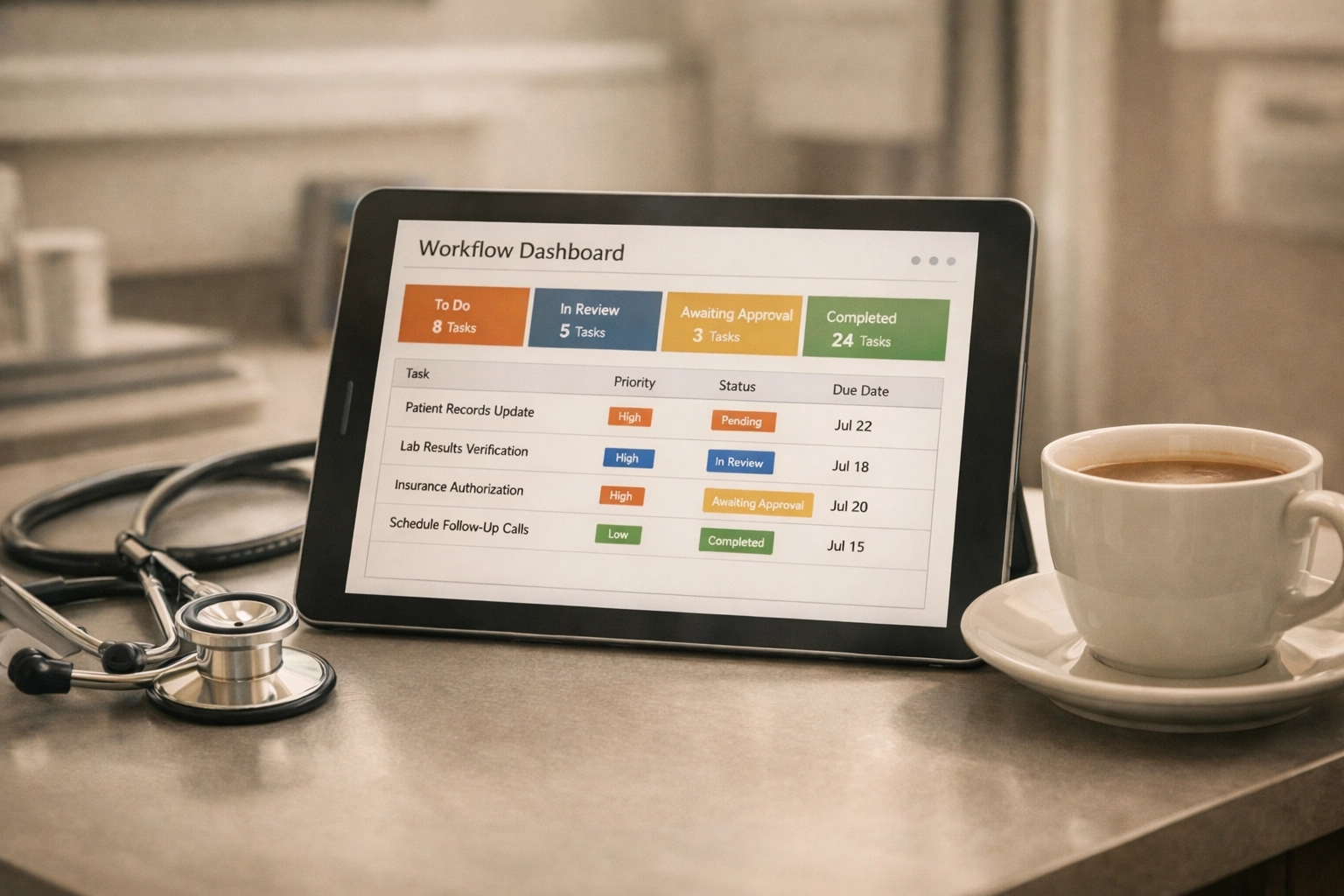
Elena established two daily "operations windows": 30 minutes at 9 AM and 30 minutes at 3 PM: for non-urgent operational questions. Everything else went into a shared task board that got reviewed during those windows.
The rule was simple: unless it's patient care or an actual emergency, it waits for the window.
Time saved: 2 hours/week (from reduced context switching).
The Results
Within three weeks, Elena's workweek dropped from 55 hours to 43. Twelve hours reclaimed. Not through hiring. Not through cutting services. Through systems that stopped demanding her attention for decisions that didn't need her brain.
"The surprising part," she said, "wasn't that I got time back. It was that the practice ran better. Smoother. Staff was more confident. Patients didn't notice any change except that I seemed less frazzled."
The financial impact? That extra time went into patient care expansion and strategic planning. Revenue increased 8% over the next quarter, while Elena's personal hours decreased.
What Made the Difference
Elena's transformation wasn't about working smarter or setting better boundaries: concepts that sound good but rarely translate to action. It was about building infrastructure that protected her time by default, not by effort.
Most practice owners try to solve operational problems with personal discipline. Elena solved them with systems.
Tomorrow, we'll tackle the objection everyone has: "But my practice is different. This wouldn't work for us."
Spoiler: it would.
Want to identify your high-impact systems changes? Book a 15-minute session and let's map them out together.
Thursday: You Don't Need More Time: You Need Better Systems
Let me guess what you're thinking after reading about Dr. Martinez's story:
"That sounds great, but my practice is different."
"My staff needs more guidance, not less."
"I've tried delegating before. It didn't work."
I hear this constantly. And here's what's really being said: "I don't trust my systems, so I can't let go of control."
Fair enough. Because most healthcare practices don't have systems worth trusting.
The Control Paradox
The tighter you hold control, the less control you actually have.
When every decision flows through you, you become the bottleneck. Your practice can't move faster than you can approve, respond, and decide. Growth is capped at your personal capacity.
"But if I don't stay on top of everything, things fall through the cracks."
Exactly. Because you haven't built systems that catch things.

The irony? You're working harder to maintain control while simultaneously losing control of your time, your schedule, and your strategic direction.
The "My Staff Needs Me" Myth
"My team isn't experienced enough to make these decisions independently."
Let me ask you this: Are they not experienced because they lack ability, or because you haven't given them the infrastructure to succeed?
Most practice owners confuse capability with clarity. Your staff isn't asking for your input because they're incapable. They're asking because:
- The decision criteria aren't documented
- The approval authority isn't clear
- The consequences of getting it wrong feel too high
- It's faster to ask you than to figure it out
When we work with practices to implement clear systems: using tools like Marblism to create automated workflows and decision trees: something interesting happens: the same staff who "needed" constant guidance suddenly become remarkably autonomous.
They didn't get smarter. The systems got clearer.
The Real Reason Delegation Fails
"I've tried delegating. It takes longer to explain than to just do it myself."
This is true… the first time.
The problem isn't delegation. It's delegation without documentation. When you verbally explain a process, you're guaranteeing you'll explain it again. And again.
Proper delegation means:
- Document the process once
- Create decision frameworks, not just task lists
- Build feedback loops that surface exceptions
- Trust the system, not just the person
When you delegate to a system rather than just a person, the knowledge transfers. New hires onboard faster. Turnover doesn't cripple operations. You don't become the single point of failure.
The Uncomfortable Truth
Most practice owners aren't overworked because their practice is complex. They're overworked because their systems are simple.
Simple systems require human judgment at every step. Complex systems, well-designed ones: make most decisions automatically and only escalate true exceptions.
You don't need simpler operations. You need more sophisticated systems that make operations simpler to manage.

What "Better Systems" Actually Means
A better system isn't more software or more rules. It's infrastructure that:
- Makes the right decision the easiest decision
- Surfaces problems before they become crises
- Transfers knowledge automatically
- Scales without requiring your personal attention
When Dr. Martinez built her approval workflow, she didn't create more bureaucracy. She created clarity. Staff knew what they could decide independently. Exceptions were flagged automatically. Nothing fell through the cracks because the system caught it.
That's not micromanagement. That's infrastructure.
The Choice You're Really Making
Every time you answer the same question twice, you're choosing personal involvement over systematic solutions.
Every time you approve a routine decision, you're choosing to be essential over building something that runs without you.
Every time you say "it's faster if I just do it," you're choosing today's efficiency over tomorrow's freedom.
I get it. Building systems takes time upfront. But so does answering the same question 50 times this year.
Tomorrow, we'll get tactical. Three specific audits you can run this weekend that will reclaim at least 5 hours next week. No theory. Just action.
Because you're right: you don't need more time. You need systems that give time back.
Ready to build systems that actually work? Schedule a 15-minute consultation and let's design them together.
Friday: 3 Systems You Can Audit This Weekend to Reclaim 5 Hours Next Week
Enough theory. Let's get tactical.
You have a weekend. You want time back next week. Here are three systems audits you can complete in 3-4 hours that will immediately reclaim 5+ hours of your workweek.
No consultants needed. No massive overhauls. Just practical fixes that compound quickly.
Audit #1: The "Recurring Questions" Log
Time investment: 60 minutes
Time reclaimed: 2-3 hours/week
What to do:
Review your email, Slack messages, and in-person conversations from the past two weeks. Look for questions that aren't patient-specific: anything related to process, policy, or procedure.
Make a list. I guarantee you'll find 10-15 questions that get asked repeatedly:
- "What's our policy on X?"
- "Who approves Y?"
- "How do we handle Z?"
The fix:
Create a shared document (Google Doc, Notion, whatever your team uses) titled "Standard Operating Decisions." Document the answer to each recurring question with:
- The question itself
- The answer
- The reasoning (optional, but helpful)
- Who to ask if the situation doesn't fit the standard answer
Share it with your team. Make it searchable. Update it when new recurring questions emerge.
Why this works: You're not answering the same question 40 times this year. You're answering it once and pointing people to the answer. Every question that shifts from "Ask the owner" to "Check the doc" saves you 3-5 minutes and eliminates an interruption.

Audit #2: The "Approval Bottleneck" Review
Time investment: 90 minutes
Time reclaimed: 2-3 hours/week
What to do:
Pull up your calendar and email for the past month. Identify every approval request that came to you: supply orders, schedule changes, vendor decisions, expense approvals, policy exceptions.
Sort them into two categories:
- Decisions that required your expertise (clinical judgment, strategic direction, major financial commitment)
- Decisions that followed a pattern (routine purchases, standard schedule swaps, normal operational adjustments)
Be honest. Category 2 is probably 70%+ of your approval volume.
The fix:
For each recurring approval type in Category 2, create a decision framework:
- What's the threshold for auto-approval? (e.g., supply orders under $500)
- Who has approval authority below that threshold?
- What criteria determine exceptions that need escalation?
Document these frameworks. Better yet, build them into an automated system using tools like Marblism, where routine approvals flow automatically and only exceptions hit your desk.
Why this works: You're not making 30 micro-decisions weekly. You're making 3-4 strategic ones. Your team gains autonomy. You gain back hours of task-switching time.
Audit #3: The "Communication Chaos" Mapping
Time investment: 45 minutes
Time reclaimed: 1-2 hours/week
What to do:
Map how information currently flows through your practice. Pick one common scenario: let's say a patient calls to reschedule.
Write down every step:
- Front desk takes call
- Front desk checks schedule
- Front desk checks provider availability
- Front desk asks manager about policy exception (if needed)
- Manager asks you (if needed)
- Confirmation gets called back to patient
- Change gets entered into system
- Change gets noted in patient file
Count the handoffs. Count the decision points. Count how many times "check with the owner" appears in the workflow.
The fix:
Redesign the workflow to minimize handoffs and clarify decision authority at each step:
- What can front desk decide independently? (reschedules within same week, same provider)
- What needs manager approval? (reschedules that affect provider workload)
- What needs your attention? (basically nothing, unless it's an unusual patient situation)
Document the new workflow. Train staff on it. Give them clear authority to act within defined parameters.
Why this works: Every eliminated handoff saves 5-10 minutes and prevents information loss. Every clarified decision point prevents an unnecessary escalation. Multiply that across dozens of daily workflows, and you've reclaimed hours.

The Weekend Game Plan
Saturday morning: Audit #1 (Recurring Questions)
Saturday afternoon: Audit #2 (Approval Bottlenecks)
Sunday afternoon: Audit #3 (Communication Chaos)
By Sunday evening, you'll have three documented systems that didn't exist Friday. By the end of next week, you'll notice the difference: fewer interruptions, faster decisions, more time for work that actually matters.
What Happens Next
These three audits address the highest-impact time leaks in most healthcare practices. They're not everything you need to fix, but they're enough to create immediate relief.
The practices that see sustainable results don't stop here. They make systems improvement a regular practice: a monthly audit, a quarterly review, continuous refinement.
Because here's the truth: you'll never "finish" building systems. But you can reach a point where systems protect your time by default, not by constant effort.
Start this weekend. Reclaim 5 hours next week. Build from there.
Need help implementing these audits? Book a 15-minute session and we'll walk through your specific practice together. Let's turn wasted time into protected time.