
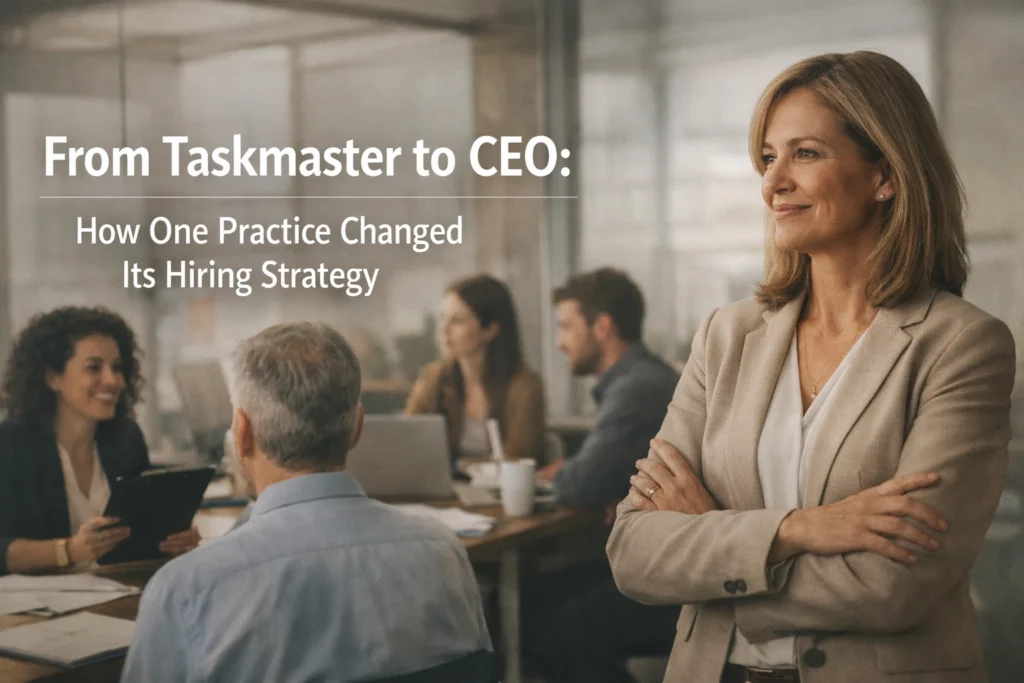
Dr. Sarah Mitchell ran a $2.3M pediatric practice in suburban Dallas. She had twelve employees, steady patient volume, and a reputation for excellent care.
She was also exhausted.
Every morning started the same way: answer emails before the first patient arrived. Between appointments, she'd field questions from her front desk about insurance verifications, approve vendor invoices her office manager forwarded, and troubleshoot scheduling conflicts. Lunch was spent reviewing the day's billing entries. Evenings meant catching up on the clinical documentation her team couldn't handle.
She wasn't practicing medicine anymore. She was managing a thousand small tasks that somehow always landed back on her desk.
"I kept hiring people," Sarah told us during our first consultation. "I'd find someone great, train them, and within six months, I'd still be doing half their job for them."
The problem wasn't the people. It was what she hired them to do.
The Task Trap

Most healthcare practice owners hire the same way Sarah did: they create a list of tasks that need doing, write a job description, and find someone to check those boxes.
Need someone to answer phones? Hire a receptionist.
Need help with billing? Bring on a billing specialist.
Need clinical support? Add a medical assistant.
It makes perfect sense. Until it doesn't.
Because when you hire for tasks, you get exactly that: someone who completes tasks. They answer the phone when it rings. They submit claims when you give them the information. They assist when you tell them what to do.
But they don't solve problems. They don't anticipate needs. They don't own outcomes.
And when something falls outside their task list? It comes back to you.
Sarah had built a team of excellent task-doers. Her front desk answered calls promptly. Her billing team submitted claims accurately. Her medical assistants followed protocols perfectly.
But nobody was thinking about why the same insurance questions kept coming up. Nobody was analyzing which billing errors cost the practice the most money. Nobody was streamlining how patient flow could improve without adding more staff.
Every process improvement, every strategic decision, every fire that needed putting out: all of it landed on Sarah's desk. She wasn't leading her practice. She was feeding it, task by task, day after day.
The Turning Point
The shift happened during a particularly brutal week. Sarah had just hired her third "practice manager" in eighteen months: another experienced healthcare administrator who looked perfect on paper.
Two weeks in, Sarah found herself explaining (again) how to handle a vendor dispute, walking through (again) the logic behind scheduling changes, and reviewing (again) a simple financial report that should have been straightforward.
"I realized I kept hiring people who could do things," Sarah said. "But I never hired anyone who could own things."
That distinction changed everything.
Hiring for Results, Not Tasks
Sarah completely rewrote how she thought about hiring for medical practices. Instead of listing tasks, she defined outcomes.
She didn't need someone to "submit insurance claims." She needed someone to own a 95% first-pass acceptance rate and reduce days in A/R.
She didn't need someone to "answer phones and schedule appointments." She needed someone to own patient access: to think about wait times, no-show rates, and scheduling efficiency.
She didn't need someone to "manage the office." She needed someone to own operational consistency so that clinical care could happen without constant interruptions.

The difference seems small. It's not.
When you hire for outcomes, you hire people who think differently. They don't wait for problems to be handed to them: they go find the problems. They don't ask you how to do their job: they figure it out and bring you solutions. They don't need daily direction: they need quarterly goals and the authority to meet them.
Sarah's next hire was Ashley, her new Director of Operations. During the interview process, Sarah didn't ask about Ashley's experience with scheduling software or familiarity with insurance protocols. She asked: "If patient wait times increased by 20% over three months, how would you diagnose the problem and what would you fix first?"
Ashley didn't just have an answer. She had a framework. She asked clarifying questions. She outlined a methodical approach that included data analysis, staff interviews, and patient feedback. She talked about piloting solutions before rolling them out practice-wide.
Sarah hired her that week.
What Changed
Within 90 days, Ashley had reorganized the entire patient flow system. She identified that the practice was scheduling too many acuity-variable appointments back-to-back, creating cascading delays. She restructured the schedule, cross-trained staff to flex between front desk and clinical support during peak times, and implemented a simple digital check-in system using Marblism to reduce bottlenecks at the front desk.
Sarah didn't ask her to do any of that. Ashley saw the problem and owned the solution.
More importantly, Sarah stopped being the bottleneck. When a billing question came up, Ashley didn't forward it: she researched it, made a decision, and documented the process so it wouldn't be a question again. When a vendor tried to increase fees, Ashley negotiated directly and brought Sarah a recommendation, not a problem.
For the first time in five years, Sarah had time to think strategically about her practice. She started exploring medical practice growth strategies she'd been putting off: adding a second location, expanding telehealth services, even taking a real vacation.
"I used to think I was the only one who could make decisions," Sarah admitted. "Turns out, I was just the only one I'd let make decisions."
The Real Cost of Task-Based Hiring

If you're reading this and recognizing yourself in Sarah's story, you're not alone. Most healthcare practice owners we work with are trapped in the same cycle.
You're growing revenue but working more hours. You're adding staff but your workload isn't decreasing. You're exhausted from making a thousand small decisions every day that someone else could be making: if only you'd hired them to think, not just do.
This isn't just about delegation. It's about scalability.
A practice built on task-based hiring hits a ceiling. Because no matter how many people you add, if they're all waiting for you to tell them what to do, you're still the constraint. You can't scale your time. You can't clone your decision-making. And you definitely can't take a week off without everything falling apart.
But a practice built on outcome-based hiring? That scales. Because you're not managing tasks: you're managing results. And results don't require you to be in the room for every decision.
Making the Shift
Changing your hiring approach isn't complicated, but it does require rethinking your job descriptions and interview process.
Stop asking: "Can you handle scheduling?"
Start asking: "How would you reduce our no-show rate by 15% in six months?"
Stop looking for: Someone with five years of billing experience.
Start looking for: Someone who can analyze claim denial patterns and implement process improvements.
Stop hiring: A medical assistant who follows protocols.
Start hiring: A clinical coordinator who owns patient flow and identifies efficiency gaps.
And most importantly, once you hire people who can own outcomes, let them own outcomes. Give them authority. Give them resources. Give them the space to think and solve problems.
Then get out of their way.
Your Next Hire
If you're about to post a new job listing, pause for a minute. Look at what you wrote. Is it a task list, or is it an outcome you need someone to own?
If it's the former, rewrite it. Because the next person you hire will either free up your time to lead your practice: or they'll just add another task to your plate.
Sarah's practice is on track to hit $3.2M this year. She works four days a week now. She spends her time on strategic planning, physician recruitment, and exploring healthcare staffing solutions that support long-term growth.
She's not a taskmaster anymore. She's a CEO.
And her team doesn't need her to tell them what to do. They already know.
Ready to rethink your hiring strategy? Book a 15-minute session and let's talk about building a team that drives results, not just checks boxes.