
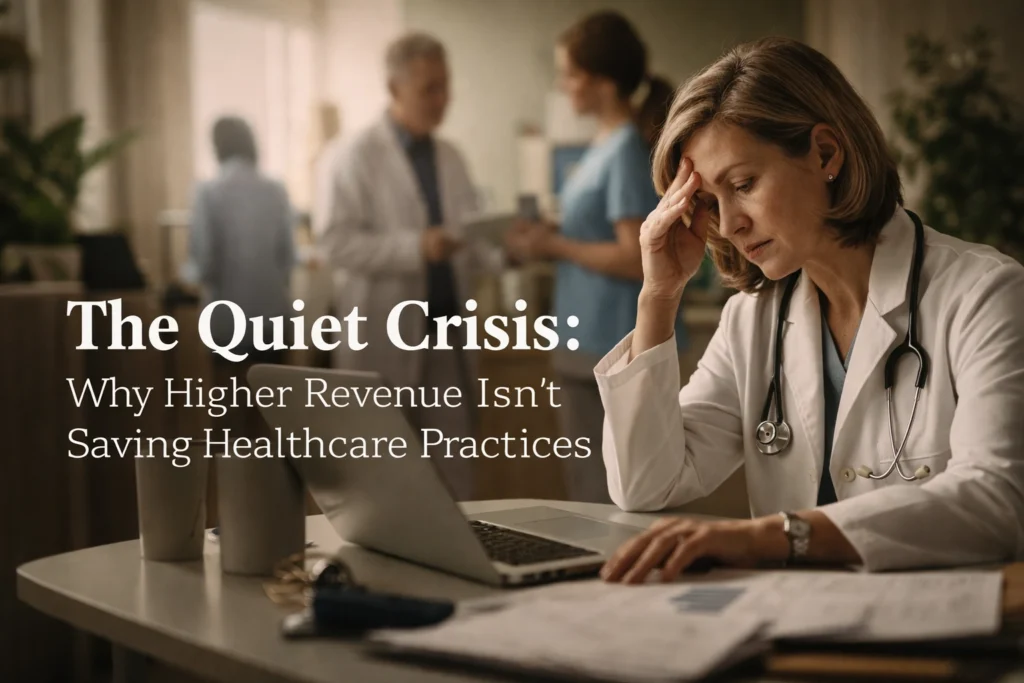
Your revenue is up. Your schedule is packed. Your team is working harder than ever.
So why does it feel like you're falling behind?
This is the quiet crisis hitting healthcare practices across the country. The numbers look healthy on the surface: but underneath, the math doesn't work anymore.
The Squeeze Nobody Talks About
Here's what's actually happening: costs are rising faster than reimbursements.
You're caught between two forces moving in opposite directions:
- Insurance reimbursements are flat: or declining
- Operational costs are climbing every quarter
Labor. Rent. Supplies. Technology. Compliance. Malpractice insurance. Every line item is up. Meanwhile, payers aren't adjusting rates to match inflation. They're tightening prior authorizations, delaying payments, and denying claims at higher rates.
The result? You're working more, collecting more gross revenue, and keeping less of it.

Why "Just See More Patients" Doesn't Fix This
The instinct is to push harder. Add hours. Stack the schedule tighter. Hire another provider.
But volume alone can't solve a margin problem.
If your cost-per-visit is rising faster than your revenue-per-visit, more volume just accelerates the bleed. You end up busier, more burned out, and still financially stuck.
This is where healthcare revenue cycle management becomes critical: not as a buzzword, but as a survival mechanism. Practices that thrive in this environment aren't necessarily seeing more patients. They're collecting more of what they're owed, faster, with fewer write-offs.
The Numbers Most Practice Owners Don't Track
Most owners know their top-line revenue. Far fewer know:
- Days in A/R (how long it takes to collect)
- Denial rate by payer (which insurers are costing you money)
- Cost per visit (what it actually costs to deliver care)
- Net collection rate (what you keep vs. what you bill)
Without these numbers, you're flying blind. You feel the pressure but can't pinpoint the source.
Strong financial systems for medical clinics start here: with visibility. You can't fix what you can't measure.
If you're building or upgrading your practice management systems, tools like Marblism can help you rapidly develop custom dashboards and workflows that give you this visibility without enterprise-level costs.
What This Means for Your Practice
This isn't a temporary squeeze. Reimbursement pressure isn't going away. Labor costs aren't dropping. Payer complexity is increasing.
The practices that survive: and grow: will be the ones that:
- Build financial systems that create real-time visibility
- Tighten revenue cycle processes to reduce leakage
- Make decisions based on margin, not just revenue
This is the work of business coaching for healthcare practices: helping owners see the real picture and build systems that protect profitability: even when external forces are working against you.
The Bottom Line
Higher revenue doesn't guarantee a healthy practice. Not anymore.
The quiet crisis is the gap between what you bill and what you keep: and it's widening for most practices every year.
The question isn't whether you're busy. It's whether you're building a business that can sustain itself through the squeeze.
Ready to see where your practice is leaking profit?
Book a 15-Min Session and let's look at the numbers together. No pressure: just clarity on what's working, what's not, and what to fix first.